The Nursery Peat Trap: Why Dense Store-Bought Mix Suffocates Roots Indoors
Store-bought peat mix is built for sunny greenhouses, not your living room. Here's why roots suffocate indoors and why gravel at the bottom makes it worse.

Dense nursery peat works great inside a bright, breezy production greenhouse and acts like a wet kitchen sponge on a living-room shelf. When you bring home a healthy Monstera deliciosa, Epipremnum aureum, or Peperomia obtusifolia in its original grower pot, that heavy soil is suddenly sitting in way less light and airflow. Seeing how water hangs onto fine peat inside a pot explains why careful plant owners still end up with suffocated roots.
Why Does Dense Store-Bought Peat Stay So Soggy at the Bottom of a Pot?
Even after a pot stops dripping in the sink, fine store-bought peat holds a soggy layer of trapped water at the bottom, often called a perched water table. When air space down there drops below 10 percent, fine roots run out of oxygen and start suffocating even if you didn't water very often.
Rocks at the Bottom Push Soggy Soil Closer to Your Roots
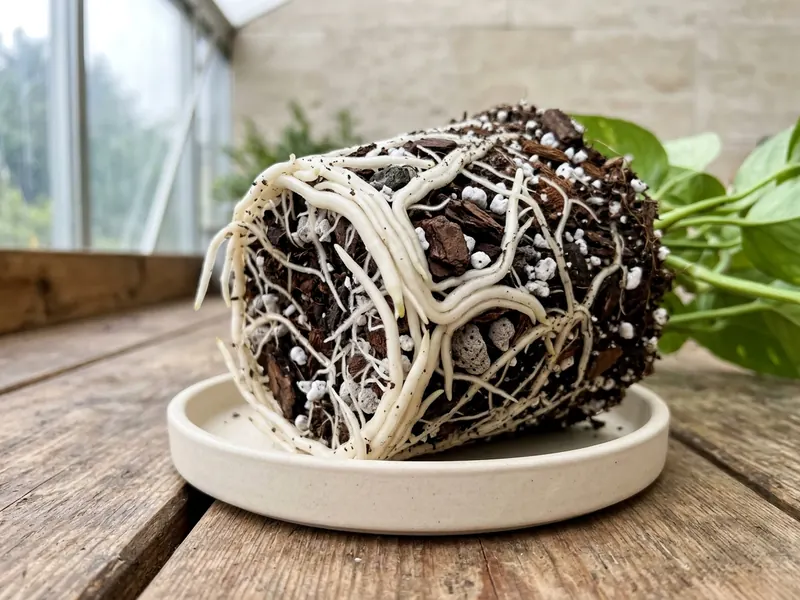
Water won't drop from fine peat into coarse gravel until the soil right above the rocks is 100% soaked.
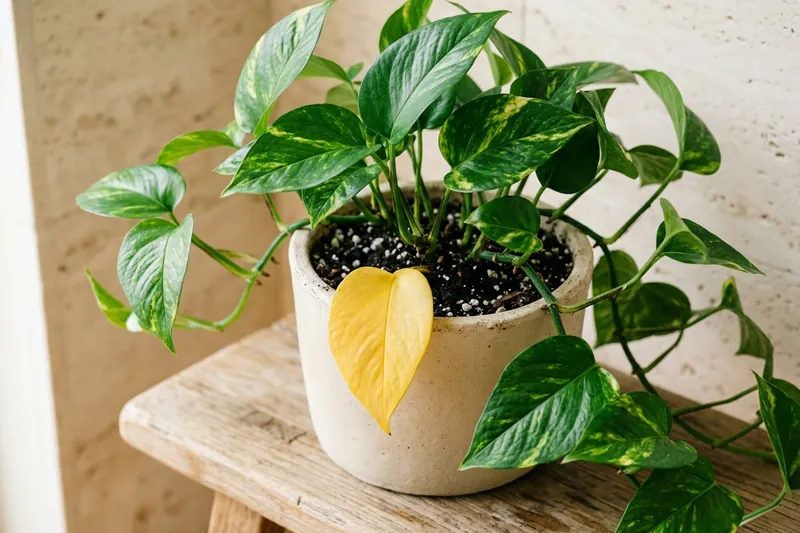
Blending chunky perlite or bark through the whole pot keeps air space above 10% from top to bottom.
Pot shape plays into this too. A taller pot leaves a deeper layer of airy soil above that wet bottom zone, whereas a squat pot packed with dense, unamended peat compacts over time and keeps wet mud pressed right up against the roots.
Does Putting Gravel at the Bottom of a Pot Help It Drain Better?
Dumping coarse gravel, pebbles, or broken pot shards in the bottom of a pot under finer soil does not improve drainage at all. Water won't move out of tiny peat spaces into big gaps between rocks until the soil right above the gravel is 100 percent soaked, which pushes that wet layer higher up into your roots and leaves less room to breathe.
Instead of hiding rocks at the bottom, two simple changes actually work with pot physics: pick a taller pot so gravity leaves more breathing room near the top, or mix chunky pieces evenly through the whole batch of soil so air space stays above 10 percent. When the whole pot has an open, chunky texture from top to bottom, excess water runs straight out the drain holes instead of pooling halfway up.
How Should You Mix Potting Soil for Regular Watering and Self-Watering Pots?
Mixing regular peat or coco coir with 20 to 30 percent coarse perlite, pumice, or orchid bark keeps plenty of air around upper roots while still letting moisture wick steadily. In a self-watering pot, water pulls upward from the bottom reservoir through small soil gaps without drowning the roots, as long as your mix is chunky and airy.
If you pack plain unamended peat into a self-watering planter, it compacts and stays way too wet, and even with a 20 to 30 percent perlite or bark mix you should rinse the pot from the top occasionally to flush out old fertilizer salts. Since indoor light drops off fast as you move back from a window, match your watering check to your plant and its light spot (most medium-light plants like 150 to 500 foot-candles, or 30 to 100 PPFD): let the top 2 to 3 in. of chunky mix dry for Monstera deliciosa (250 to 700 FC, 4 to 8 ft tall indoors), let the top 50 percent dry for Epipremnum aureum (75 to 400 FC), and let thick-leaved Peperomia obtusifolia (150 to 450 FC, 8 to 12 in. tall) dry 60 to 75 percent.
Which Common Potted Plants Need Pet-Safety and Outdoor Disposal Care?
According to ASPCA toxicology records, Monstera deliciosa and Epipremnum aureum carry insoluble calcium oxalate crystals that cause mouth irritation, pawing at the face, drooling, and vomiting in cats and dogs, while Peperomia obtusifolia is listed as non-toxic to cats and dogs. In frost-free USDA Zones 10 to 12, fast-growing tropical vines like Epipremnum aureum can also escape outdoors and smother native tree canopies, so root cuttings inside or seal trimmings in household trash instead of tossing them into yard waste.
When you want to pair compact plants and a chunky 20 to 30 percent perlite or bark mix with bottom wicking, The Plant Roast's Side-Eye ($35 USD) is an asymmetrical 4-inch self-watering PLA planter 3D-printed in the USA with an internal reservoir and floating water-level indicator. Physical on-hand shelf stock is currently zero, so check live made-to-order availability or join our restock waitlist.
References
- Passioura, J. B. (2006). The perils of pot experiments. Functional Plant Biology, Vol. 33, Issue 12, pp. 1075-1079. DOI:10.1071/FP06223
- Chalker-Scott, L. (2019). The Myth of Drainage Material in Container Plantings. Washington State University Cooperative Extension Horticultural Myths Series. EXT_ID:WSU-EXT-DRAINAGE-01
- Chen, J., McConnell, D. B., Henny, R. J., & Norman, D. J. (2020). Cultural Guidelines for Commercial Production and Interior Acclimatization of Tropical Foliage Plants. University of Florida IFAS Extension (UF/IFAS), Bulletin ENH957 / CIR480. EXT_ID:UF-IFAS-ENH957
- Ferrarezi, R. S., Weaver, G. M., van Iersel, M. W., & Testezlaf, R. (2015). Subirrigation: Historical overview, challenges, and future prospects. HortTechnology, Vol. 25, Issue 3, pp. 262-276. DOI:10.21273/HORTTECH.25.3.262
- ASPCA Animal Poison Control Center (2024). Toxic and Non-Toxic Plants Database: Araceae, Moraceae, Asparagaceae, Begoniaceae, Polypodiaceae, Apocynaceae, and Marantaceae. American Society for the Prevention of Cruelty to Animals (ASPCA) Veterinary Toxicology Registry. ASPCA_ID:ASPCA-APCC-PLANTS-2024
- University of Florida IFAS Assessment of Non-Native Plants (2023). Indoor Containment and Responsible Disposal of Tropical Vines (Epipremnum pinnatum / aureum & Syngonium) in Frost-Free Zones. UF/IFAS Center for Aquatic and Invasive Plants Assessment. EXT_ID:UF-IFAS-INVASIVE-EPI

